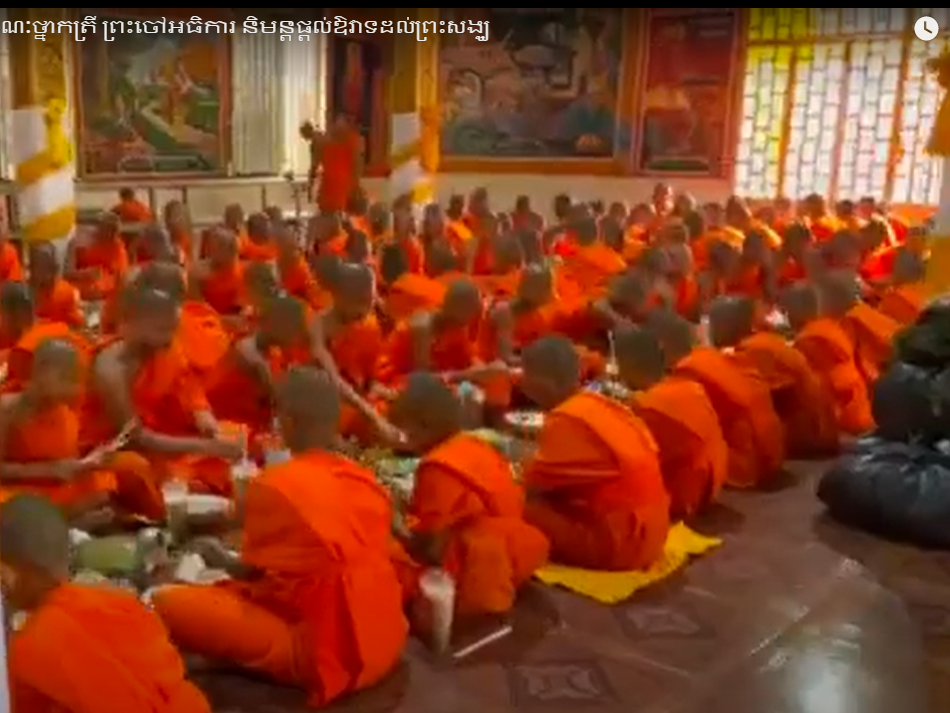
Meeting Dhammarato and practicing the real teachings of the buddha is one of the greatest things I have ever done 🤜🤛
Views: 1
Put anything here not easily put elsewhere
Views: 1
I say, bhikkhus, that ignorance has a nutriment; it is not without nutriment. And what is the nutriment for ignorance? it should be said: the five hindrances.
The five hindrances, too, I say, have a nutriment; they are not without nutriment. And what is the nutriment for the five hindrances? It should be said: the three kinds of misconduct.
The three kinds of misconduct, too, I say, have a nutriment; they are not without nutriment. And what is the nutriment for the three kinds of misconduct? It should be said: non-restraint of the sense faculties.
Non-restraint of the sense faculties, too, I say, has a nutriment; it is not without nutriment. And what is the nutriment for non-restraint of the sense faculties? It should be said: lack of recollection and awareness.
Lack of recollection and awareness too, I say, has a nutriment; it is not without nutriment. And what is the nutriment for lack of recollection and awareness? It should be said: no concurrent attention.
No concurrent attention too, I say, has a nutriment; it is not without nutriment. And what is the nutriment for no concurrent attention? It should be said: lack of trust.
Lack of trust, too, I say, has a nutriment; it is not without nutriment. And what is the nutriment for lack of trust? It should be said: not hearing the good Dhamma.
Not hearing the good Dhamma, too, I say, has a nutriment; it is not without nutriment. And what is the nutriment for not hearing the good Dhamma? It should be said: not associating with good people.”
—AN 10.61
Views: 4
“Those who are skilled in the meaning of scripture
should practice like this so as to realize the state of peace.
Let them be able and upright, very upright,
easy to speak to, gentle and humble;
content and unburdensome,
unbusied, living lightly,
alert, with senses calmed,
courteous, not fawning on families.
Let them not do the slightest thing
that others might blame with reason.
May they be happy and safe!
May all beings be happy!
Whatever living creatures there are
with not a one left out—
frail or firm, long or large,
medium, small, tiny or round,
seen or unseen,
living far or near,
those who have been born
and those about to be born—
may all beings be happy!
Let none deceive another,
nor look down on anyone anywhere.
Though provoked or aggrieved,
let them not wish pain on each other.
Even as a mother would protect with her life
her child, her only child,
so too for all creatures
unfold a boundless heart.
With love for the whole world,
unfold a boundless heart:
above, below, all round,
unconstricted, without enemy or foe.
When standing, walking, sitting,
or lying down while yet unweary,
keep this ever in mind;
for this, they say, is a divine meditation in this life.
Avoiding harmful views,
virtuous, accomplished in insight,
with desire for sensual pleasures dispelled,
they never return to a womb again.”
—Kp 9
Views: 0

Here is a link to the Dhamma Friends discord if you are interested in an open space to share Dhamma.
Views: 1
We started from the concept of triple gem, in which dhammarato said that the most important of the three is actually the sangha, that in fact had originated at the time of the Buddha, when bhikkhus started to get along in nobility and friendship with one another. The triple gem is in fact being friend on the inside, friend on the outside and so developing the qualities of the buddha. In fact we heard many times how buddhism and dharma is based upon friendship, noble friendship.
So then we came to the mission itself, which is about networking for people who want to join or continue to stay on the path, facilitating them with some structure as a reference point and facilitating major life changes that many people are going through in their lives.
In fact the OSF will reach:
Monks (ajahn, – some names are in the recording) who already teach the noble dharma to add sangha to their teaching equation.
Affirmed western teacher to bring in the dana orientation
But also: aspiring teachers or teachers that want to get established, so that they can find a context of support and reference point trough “eastern oriented” existing buddhist structures
The idea is to remove the exchange of money
But also: people who want to go to asia, to give them support finding facilities, friends, monks, noble monks and learn from the asian perspective.
But also: people who just google dharma
Then we went again through the importance of friendship on how the OSF will bring together different buddhist traditions and people will have the possibility to get along for similarities rather than arguing on the differences, accumulated by the movement of change that is going through their lives.
Here some other features of the website:
website meetings, groups, spread the dharma, contact teachers, meet and greet—meet friends and stay. western community.
website helping people find temples, clubs, organizations near them and map it.
profile of volunteers with bio.
donation
Here some values: Morality (came after wisdom) Joy, friendship
To say that the community is already forming, and this website will facilitate.
In the end, personally I would say that this is the opportunity for people to jump, or follow the stream. change ther lives, let go of their job and the bank account and jump right in completely.
Dhammarato picks up new people, but there will come a point when he will not have the power to help us further, and so the network will be of primary importance. again for this reason is a pleasure for me to help build and develop the sangha. HAVE A GREAT DAY, SEE YOU SOON FRIEND!
Views: 1
 [pdfjs-viewer url=”https://alextest.opensanghafoundation.org/wp-content/uploads/2023/08/A-Buddhist-Charter-Buddhadasa.pdf” attachment_id=”7993″ viewer_width=100% viewer_height=800px fullscreen=true download=true print=true]
Views: 2
[pdfjs-viewer url=”https://alextest.opensanghafoundation.org/wp-content/uploads/2023/08/palichanting_urw_csx_short.pdf” attachment_id=”8007″ viewer_width=100% viewer_height=800px fullscreen=true download=true print=true]
Views: 1

I came to Sunyata for 5 days (1/12/2022-5/12/2022) and I was very impressed by how such a small
monastery can have such a big impact. The schedule ran like the other wats in this forest thai tradition
(with Ajahn Chah) such as Chithurst, Amavarati – there was about 3 hours work to be done the entire
day with everything being ran off of dāna, breakfast, lunch, tea and the two daily hour pujas I attended.
In the barren countryside of Ireland it’s very personal experience in polarity to the busyness of other
wats, there was 3 other guys in the entire place so I was left alone for most of the day to the chatters of
my mind, which proved to be a new experience and a very insightful to see my mind in such social
seclusion. There was no monastics about although recently Ajahn Succito resided a while for a self-
retreat, there are generally lay visitors coming and going and a couple dedicated long-term laypeople
who stick around who worked quite a bit to maintain the place and keep up the handling of retreats and
so on. It still somehow felt like a Sangha with those guys, we openly could talk and relate to each other
on many levels of personal experience in life and our experiences in meditation, it felt really nice to be
able to find a place in my home country who practiced, sharing connections and places to meet Sangha
is pretty solid.
The place itself is really very simple and after roaming around it is easy to tell they’ve spent a lot of time
cultivating a very aesthetically beautiful place with a bit of land for herbs and vegetables, you have your
room in a dormitory (although the entire dorm will likely be your room if you’re not in some
retreat/event) and do whatever you want. There are free books to read if you like and a comfortable hall
to sit in during the common showery cold Irish days and the only thing you’ll be disturbed by is a dog
and a few cats. There is literally nothing to do and nowhere to go. (welcome to anapanasati)
After the morning reflection, work begins, you will be likely off to do your own task and it is very nice to
practice working meditation as that is something quite mentioned in this tradition, to approach
absolutely everything with mindfulness even the most mundane of things. (where I saw my mind prefers
to be the most active).
It is good to bring any kind of dāna you can whether that be some groceries from the nearby town of
Sixmilebridge or donations, this is a very small place and generally they have to do their own shopping
from retreat donations, but don’t worry if you can’t because there is plenty of food to go around. Being
no monastics has its downside of not being able to talk about your practice or observe long-term
practitioners who can make great friends or teachers, so I suggest if you are a point you’d like a self-
retreat this is definitely a good place to go or to join during some kind of retreat where you’ll be
amongst more people, or to be in contact with the lay-manager as to when monastics are coming and
going. I’ll absolutely be back and for anyone in Ireland this is certainly a place you’ll be glad to be able to
visit often.
Views: 3

Even when ‘vedanā’ is not being spoken of in the context of ‘satipatthāna’ or foundation of mindfulness, generally speaking it is nevertheless an important matter in the Buddhist religion, for, actually it is one of the various matters that form the heart of the religion, because all the mental defilements, cravings, attachment (upādāna) and suffering all come from ‘vedanā’ or feelings. Happy feeling or ‘sukha-vedanā’ leads to one kind of defilement (kilesa) while unhappy feeling (dukkha-vedanā) leads to another kind of mental defilement. Mental defilement is a kind of craving and craving leads to the rise of the tendency to feel or to get attached to things and phenomena, and that in turn leads to suffering. Thus, ‘vedanā’ is a big issue and it is initially the igniting point of craving. It is the second of the Four Noble Truths—the ‘Samudaya’ or the origin of suffering. If you wish to know how craving arises, learn about ‘vedanā’ and you will come to know it well that ‘sukha-vedanā’ brings about one kind of mental defilement (kilesa or craving) while ‘dukha-vedanā’ causes another kind of craving. Do take some interest in this matter.” —Ajahn Buddhadasa Bhikku
Views: 2